Art and Time | Media

SS26 // COUNTER-IMAGES | COUNTER-NARRATIVES: FEMINIST AESTHETICS IN ART AND CINEMA

Seminar and Interdisciplinary Dialogue between the Film Academy Vienna & the Academy of Fine Arts Vienna
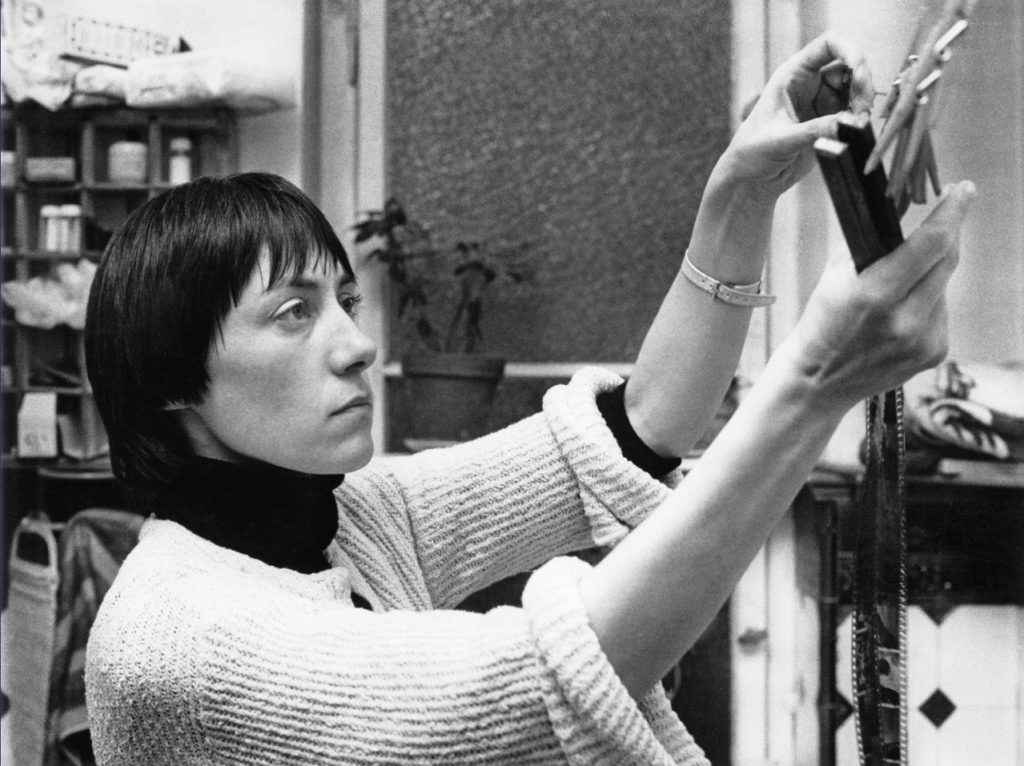
Helke Sander: Die allseitig reduzierte Persönlichkeit – Redupers (The All-Round Reduced Personality – Redupers), 1978, BRD, BW, 98 min.

In this teaching-research seminar, we analyze and discuss historical as well as current feminist film-aesthetic strategies. The focus is on materialist-feminist and intersectional critical approaches that examine the interlinking of aesthetic forms with societal relations of production and power. This perspective includes a critique of capitalism dimension that specifically interrogates the conditions of artistic production, the valorization logics of aesthetic labor, and the emancipatory potentials of critical practices. The aim is to understand how filmic and artistic works not only represent social relations but produce and reproduce them—and how they simultaneously open up possibilities for intervention to critique and transform dominant relations. Filmmakers and theorists will be invited for dialogue in order to bring art and film as well as theory and practice into productive exchange. The events aim to contribute to sharpening awareness of feminist film history and aesthetics and to encourage the development of one’s own artistic and theoretical engagements.
This event is a collaboration between Prof. Christine Lang (Media and Film Studies | Film Academy Vienna) and Prof. Constanze Ruhm (Art and Time—Media | Institute for Fine Arts). It positions itself as an interdisciplinary dialogue between the Film Academy Vienna and the Academy of Fine Arts Vienna. COUNTER-IMAGES / COUNTER-NARRATIVES: FEMINIST AESTHETICS IN ART AND CINEMA will be held in the summer semester 2026 as well as in the winter semester 2026/27.

PROJECT

As part of the seminar COUNTER-IMAGES | COUNTER-NARRATIVES, a project is proposed in which students form small groups to collaborate on the seminar theme.
There is the option to develop free projects. Alternatively, students may engage with a historical film work – in line with the seminar’s focus on feminist film collectives. A list of relevant films is provided; all listed films are accessible and can be used as reference points for project work.

THEMATIC FOCUS AREAS

1. Invisible Labor / The Body as Economy: Feminist Positions on the Critique of Capitalism


FILMS
Sally Potter: The Gold Diggers (England 1983)
Alice Rohrwacher: Lazzaro felice /Lazzaro Felice (Italien 2018)
Marta Rodriguez: Chircales/The Brickmakers (Kolumbien 1972)
Agnès Varda: Les glaneurs et la glaneuse (Frankreich 2000) 
Martha Rosler: Semiotics of the Kitchen (USA 1975)
Helke Sander: Redupers (Deutschland 1978)
Tatjana Turanskij: Ein flexible Frau (Deutschland 2010)
Helma Sander Brahms: Unter dem Pflaster ist der Strand (Deutschland 1975) 
Erika Junge: Warum ist Frau B. glücklich? (Deutschland 1968)
Kelly Reichardt: Wendy and Lucy (USA 2008) 

2. Feminist Perspectives on Care Work, Self Exploitation, Precarization

FILMS
Geri Ashur, Peter Barton, Marilyn Mulford, Stephanie Pawleski: Janie’s Janie (USA, 1971)
Hito Steyerl: Factory of the Sun (Deutschland, 2015)
Hito Steyerl: Mechanical Kurds (Deutschland, 2025)
Carmen Trocker: Personale (Italien / Österreich, 2024)
Sheila McLaughlin, Lynne Tillman: Committed (USA, 1984)
Helke Sander: Eine Prämie für Irene (BRD, 1971)
Elisabeth Subrin: Maria Schneider, 1983 (Frankreich / USA, 2022)
Helma Sanders-Brahms: Die industrielle Reservearmee (BRD, 1971)
Claudia von Alemann: Es kommt drauf an, sie zu verändern (BRD, 1972/73)
Yvonne Rainer: Lives of Performers (USA, 1972)

3. Queer Cinema as Counter Narrative

FILMS
Jessica Dunn Rovinelli: So Pretty (USA/Frankreich, 2019)
Jane Schoenbrun: We’re All Going to the World’s Fair (USA, 2021) Jane Schoenbrun: I Saw the TV Glow (USA, 2024)
Barbara Hammer: Nitrate Kisses (USA, 1992)
Angelika Levi: Mein Leben Teil 2 (Deutschland/Chile, 2003)
Sarnt Utamachote: I Don’t Want to Be Just a Memory (2024)
Zara Zandieh: Octavia’s Visions (Deutschland, 2021)
Samira Elagoz & Z Walsh: You Can’t Get What You Want But You Can Get Me (Niederlande/Finnland, 2024)
Céline Sciamma: Tomboy (Frankreich, 2011)
Lola Arias: Reas (Argentinien/Deutschland/Schweiz, 2024)
Monika Treut: Gendernauts (Deutschland, 1999)

4. Feminist / intersectional Film Collectives: Selected historical and contemporary positions

    Rojava Film Commune | Palestinian Cinema Unit | Karrabing Film Collective | Cine Mujer | Les Insoumuses | Collectif 50/50 | Collettivo Femminista di Cinema | Le Nemesiache | Kaidu Club | Berwick Street Film Collective London Women’s Film Group | Sheffield Film Co-op | New York Newsreel


    Rojava Film Commune | Nothern and Eastern Syria

    Exemplary Films:

    Kobanê – كوباني / Kobanê (2022)
    Evîna Kurd / Kurdish Love – Evîna Kurd (ئه‌ڤینا کورد) (2017/18, Serie)
    Darên bi tenê / Lonely Trees – دارێن بێ تەنێ / Darên bi tenê (2017)
    Love in the Face of Genocide – Evîn di Rûyê Qirkirinê De (ئه‌ڤین دی ڕووی قه‌یرکرین2020)

    Links


    The Rojava Film Commune, also called Komîna Fîlm a Rojava, is a film-artistic collective from the autonomous region of Rojava in northern and eastern Syria. It was founded in 2015 in the context of the Rojava Revolution and understands film not only as a means of artistic expression but as part of a comprehensive social and political transformation process. The collective’s aim is to build an independent local film culture and to tell stories from the region from the perspective of the people living there, beyond external or purely conflict-oriented narratives.
    The collective is deliberately organized non-hierarchically; decisions are made collectively, and film production is understood as a collective process. In terms of content, the collective’s work deals with everyday life in Rojava, with resistance, self-organization, gender justice, and the social changes that have emerged from the revolution. Fiction films, documentaries, short films, and series are produced that both document local experiences and reflect on political and social questions.
    A central component of the work is the Rojava Film Academy, where people from the region are trained practically and theoretically in all areas of filmmaking. Additionally, the collective organizes film festivals, mobile cinema screenings in cities, villages, and refugee camps, as well as international screenings and exhibitions. In this way, cinema is made accessible even where there is no traditional infrastructure, while simultaneously enabling exchange with an international audience. Overall, the Rojava Film Collective understands itself as a cultural project that connects art, education, and political practice, and employs film as a tool of collective self-empowerment.
    “Kobanê” is a feature film from 2022 about the siege and defense of the city of Kobanê against the “Islamic State” (IS). Directed by Özlem Yasar and produced by the Rojava Film Commune, it traces the story of the fighters and places strong focus on the role of Kurdish women in the battles. The film premiered, among other places, in the city of Kobanê itself and deals with real events of the conflict surrounding this symbolically significant city.
    “Evîna Kurd” (also known as Kurdish Love) is not a single feature film production but a longer series realized by the Rojava Film Collective. It tells the story of a Kurdish family in northern and eastern Syria after the Rojava Revolution and comprehensively addresses the social changes that have taken place in the region since 2017/2018.
    Other films connected to the Film Commune and often shown at screenings or festivals are documentaries such as “12×1” (2016), which accompanies the collective process of film production and training at the Rojava Film Academy, and “Darên bitenê” (Lonely Trees, 2017), which portrays traditional dengbêj music as cultural heritage and memory culture in the region. These films reflect the cultural and social reality on the ground rather than being classical fiction films.
    Another documentary approach by the collective is the film “Love in the Face of Genocide” (2020), which deals with the oral literature of Yazidi dengbêj in Shengal and preserves and makes visible their stories and survival narratives.
    Finally, the collective has also accompanied “Jinwar” (2024), a documentary about the ecological women’s village Jinwar in northeastern Syria, which functions as a social space for women from different communities and was produced or supported by the commune.


    Palestinian Cinema Unit | 1968/69 Palästina
    Exemplary Films:
    No to a Peaceful Solution – لا لحل سلمي 1969
    With Soul, With Blood – بالروح والدم (1971)
    Al Arqoub – العرقوب 1972
    Scenes from the Occupation, Gaza – مشاهد من الاحتلال، غزة 1973They Do Not Exist – هم غير موجودين (1974)
    Palestine in the Eye – فلسطين في العين 1977
    Children Without Childhood – 1979/80 أطفال بلا طفولة
    Women in Palestine – نساء في فلسطين (späte 1970er Jahre)


    The Palestinian Cinema Unit (PCU) was from the outset not only a political media project but also a space in which women played a central role. Already at its founding in the late 1960s, Palestinian women filmmakers were actively involved in building, production, and archiving. Women like Sulafa Jadallah, one of the first Palestinian camera operators, and Khadijeh Habashneh, who later took on a key role in the organization and preservation of the film heritage, decisively shaped the work of the unit. Thus, the history of the PCU contradicts the widespread image of an exclusively male-dominated revolutionary cinema and shows that women were involved from the beginning in the visual self-representation of the Palestinian liberation struggle.
    The PCU emerged around 1968/69 in the immediate aftermath of the Six-Day War and initially formed in Amman as part of the Palestine Liberation Organization. Its goal was to use film as a tool of political resistance and collective memory. The unit understood cinema not as neutral documentation but as an active intervention in global image politics: Palestinians were to represent themselves and tell their history from their own perspective, rather than remaining the object of external, often colonially shaped narratives. In this context, the participation of women was particularly significant, as they made visible not only militant but also social, everyday, and emotional dimensions of life in exile and under occupation.
    In the early years, the PCU worked with very limited technical means. What were primarily filmed were short documentary films about demonstrations, political meetings, life in refugee camps, and armed resistance. These films circulated internationally through solidarity networks, trade unions, student groups, and political organizations. The collective working method was central: tasks such as camera work, editing, organization, and distribution were shared, knowledge was passed on, and an alternative production culture was deliberately built up that set itself apart from commercial or state film industries.
    In the 1970s, the PCU developed further organizationally and was absorbed into the Palestinian Cinema Institute, which functioned as the media arm of the PLO. During this phase, dozens of films were created that are today considered the foundation of Palestinian political cinema. Women were present here not only as camera operators or organizers but increasingly also as voices shaping content, particularly in archival work and in the question of how Palestinian history could be visually preserved and passed on. This archival dimension—often carried by women—proved in the long term to be as important as actual production.
    A dramatic rupture occurred in 1982 with the Israeli invasion of Lebanon. The expulsion of the PLO from Beirut led to the destruction, dispersal, or confiscation of large parts of the PCU’s film archive. This loss is today understood as a form of cultural violence and epistemic erasure, as it affected not only material films but also visual history and collective memory. Precisely the work of those women who were responsible for ordering, cataloging, and preservation gained enormous significance in retrospect, as many films survived only thanks to international copies and informal networks.
    Today, the Palestinian Cinema Unit is considered a key project of Palestinian film history. It established a tradition of resistant, collective, and transnational cinema and sustainably influenced later generations of Palestinian filmmakers. Increasing research into its history finally also places the role of women and women filmmakers at the center and makes visible that Palestinian political cinema was from the beginning a shared, cross-gender project—sustained by the conviction that images are a decisive field of struggle for self-determination.
    Among the best-known productions of the PFU/PCI are early political and documentary works such as “No to a Peaceful Solution” (1969), a film that explicitly takes a position against political compromises in the liberation struggle, as well as “With Soul, With Blood” (1971) and “Al-Arqoub” (1972), which show everyday life, resistance, and political mobilization. These films were produced as collective works of the PFU, often with division of labor within the team and shared credits.
    Another central contribution is “Scenes of the Occupation from Gaza” (1973), which was produced by the then Palestine Cinema Group—a direct precursor to the PFU—and attracted great attention at festivals upon its release. Equally important is “Palestine in the Eye” (1977), which engages with the life and work of PFU members and documents the collective production practice as well as the role of resistance in cinematic creation.
    Women-related and women-co-created films of the collective or the PCI are particularly noteworthy: “Children Without Childhood” (1979–80), also called “Children Nevertheless,” was written and filmed by Khadijeh Habashneh herself, who played a crucial role in the PFU/PCI as archivist and filmmaker. In this documentary context, the film reflects the effects of war, displacement, and occupation on children, thereby establishing an emotional and social perspective that goes beyond classical political documentaries. Also by Habashneh is the film “Women in Palestine” (late 1970s), which from a feminist perspective addressed everyday life, resistance, and social roles of women in Palestinian society; unfortunately, this film is today considered lost, as many archives were destroyed or confiscated during the Israeli invasion of Beirut in 1982.
    Further films from the PFU/PCI phase include political short pieces such as “They Do Not Exist” (1974), which directly addresses the famous statement by then Israeli Prime Minister Golda Meir (“There was no Palestinian state, so there were no Palestinians”), as well as other documentary works about occupation, war, and collective memory.
    Although many works are no longer fully preserved or are difficult to access, the PFU/PCI filmography is considered key to the history of Palestinian resistance cinema and shows how film was used as a political and cultural instrument—not least through the participation of women like Khadijeh Habashneh and Sulafa Jadallah.


    Karrabing Film Collective | 2008 · Northern Territory, Australien

    30–50 active members; Belyuen-Community. Indigenous media collective; “improvisational realism”; Topics: Colonial Violence, Land Rights, Environment
    Exemplary Films
    When the Dogs Talked (2014)
    Windjarrameru, The Stealing C*nt$ (2015)
    Wutharr, Saltwater Dreams (2016)


    The Karrabing Film Collective did not emerge from an established art scene or a film school environment, but arose directly from a political and social crisis. Belyuen, a community in the coastal region of Australia’s Northern Territory, emerged from an internment camp of the 1940s. In 2007, the Australian federal government imposed the Northern Territory National Emergency Response—known as “The Intervention”—a comprehensive package of measures that, while suspending key anti-discrimination laws, specifically targeted Indigenous communities. The trigger was a 2007 report on alleged child neglect that created an inflamed moral and political climate.
    Subsequently, a violent conflict over land claims erupted within Belyuen, in the course of which around thirty people became homeless. Elizabeth Povinelli, who has been connected to the community since 1984—she had been invited as a philosophy student by the elders to support them in a land rights case—recalls that ABC Radio wanted to report on the situation. The community, however, declined, convinced that coverage by a state broadcaster would inevitably distort their position and instrumentalize it politically.
    The idea of a film collective took shape around 2009 on a beach at the edge of Anson Bay, during an early phase of homelessness for those involved. Linda Yarrowin, one of the founding members, took up an idea from Trevor Bianamu, who had simply expressed the wish to be a “movie star.” Her proposal was to make a small film about what their world actually looks like. At that time, those involved lived neither in the bush nor in the city under stable conditions; both spaces were marked by precarity, state intervention, and social disintegration.
    The first short film, “Low Tide Turning,” was finally made in 2012 with the support of filmmaker Liza Johnson. After that, the collective worked completely independently, initially with simple handheld cameras, later increasingly with mobile phones. This technical reduction was not a deficiency but a conscious decision in favor of autonomy and control over the production process.
    The only complete membership list that is publicly accessible comes from the Asia Pacific Triennial (APT9). It includes: Cameron Bianamu, Gavin Bianamu, Sheree Bianamu, Telish Bianamu, Trevor Bianamu, Danielle Bigfoot, Kelvin Bigfoot, Rex Edmunds, Claudette Gordon, Ryan Gordon, Claude Holtze, Ethan Jorrock, Marcus Jorrock, Melissa Jorrock, Reggie Jorrock, Patsy Anne Jorrock, Daryl Lane, Lorraine Lane, Robyn Lane, Angelina Lewis, Cecilia Lewis, Marcia Lewis, Natasha Lewis, Elizabeth A. Povinelli, Quentin Shields, Aiden Sing, Kieran Sing, Shannon Sing, Rex Sing, Daphne Yarrowin, Linda Yarrowin, Roger Yarrowin, and Sandra Yarrowin. Thus, a total of 33 members are listed by name; with the exception of Elizabeth A. Povinelli, all are Indigenous Australians from Belyuen. However, the group size is not static: Povinelli reports in interviews that the membership number was long given as “30,” now more like “50,” “although really there might be 70.” Currently, about ten younger members between the ages of 15 and 30 are emerging as new Karrabing leaders.
    The group describes their working method as “improvisational realism.” There are neither scripts nor formal pre-production meetings. One person contributes a story—a broken boat, stolen alcohol, a jealous man—others change or shift the narrative focus, either before filming begins or during it. Dialogues and scenes are created improvisationally. The basis is always concrete everyday experiences of the members: evictions by housing corporations, police violence, illegal mining on sacred sites, incarceration of youth, or dealing with state social and control systems. The choice of technology—iPhones and simple handheld cameras—is also programmatic: it enables production without external protocols, without crew apparatus, and without the takeover of control by outsiders.
    Formally, the collective is registered as a non-profit, tax-exempt organization with donation eligibility under the Office of the Register of Indigenous Corporations: as Karrabing Indigenous Corporation. In collaboration with institutions such as Serpentine London, the Aboriginal Areas Protection Authority, and the Indigenous Language and Arts Program, the group developed KARA (Karrabing Art Residency for the Ancestors). The goal of this project was an ecologically sustainable residency that does not primarily serve film production but is conceived above all as an open-air gallery whose central addressees—in the project’s own logic—are the ancestral totems. Beyond this, the Karrabing appropriate Western mapping technologies such as GIS and GPS in order to reinterpret them: not for surveying property, but for developing a cartography determined by the agency of totems and ancestral relations.

    Cine Mujer | 1978–late 1990s · Bogotá, Kolumbien
    Members: Eulalia Carrizosa, Patricia Restrepo, Clara Riascos, Sara Bright, Patricia Alvear
    One of the world’s longest-running feminist film collectives (~20 years); transition from experimental film work to educational videos for state and international institutions; also a distribution company for Latin American women’s cinema.


    Exemplarische Filme
    Carmen Carrascal (1982)
    La mirada de Myriam / Myriam’s Gaze (1987)
    Mi día / My Day (1995)
    Cine Mujer was founded in 1978 in Bogotá, in a Latin American context in which a broad-based movement of revolutionary cinema had existed since the 1950s but was largely dominated by male voices. Women who worked in these revolutionary film and activism contexts faced the same patriarchal structures that they were politically seeking to overcome. A decisive moment for Cine Mujer was the first Latin American and Caribbean Feminist Encuentro held in Bogotá in 1981. This meeting enabled transnational networking for the first time, through which feminist film works could circulate, be discussed, and be embedded in a common political horizon. Clara Riascos, one of the co-founders, later emphasized the theoretical significance of these Encuentros: they marked the point at which the exchange between film practice and feminist political discourses became concrete and productive.
    The core group of Cine Mujer consisted of Eulalia Carrizosa, Patricia Restrepo, Clara Riascos, Sara Bright, and Patricia Alvear. A video essay created in 2018 that retrospectively documents the work of the collective is carried by three of these women—Carrizosa, Restrepo, and Riascos. In semi-structured interviews, personal, professional, and political experiences intertwine into a collective self-history of the collective.
    The development of Cine Mujer can be divided into three phases. In the early phase, experimental, artistic forms were central. One example is “Carmen Carrascal” (1982), a film about a woman from a poor region who makes her living weaving baskets. Directed by Eulalia Carrizosa, with sound recording by Sara Bright, the film emerged from a personal encounter: Carrizosa learned Carmen Carrascal’s story on the occasion of an award ceremony by Artesanías de Colombia.
    This was followed by a more experimental phase with hybrid forms between fiction and documentary, such as “La mirada de Myriam” (1987), which portrays the life of a single mother on the outskirts of Bogotá. In a third phase, the focus shifted toward institutionally funded educational and awareness films, including “Mi día” (1995), produced for the UN World Conference on Women in Beijing, as well as “Ciudadanía plena” (1998). This transformation from independent film practice to a media organization that specifically produced pedagogical videos on institutional commission is one of the central and simultaneously most ambivalent aspects of Cine Mujer’s history.
    Beyond production, Cine Mujer also functioned as a distribution platform for Latin American women’s cinema. Their own films were initially shown in Colombian cinemas as part of the state FOCINE initiative, primarily for an urban middle-class audience, and later presented at festivals in Cartagena, Bogotá, Bucaramanga, as well as internationally. With a letter from Patricia Alvear dated November 17, 1999, the collective’s archive was transferred to the Colombian Film Heritage Foundation. Today, however, this archive is fragmented: parts are digitized and accessible through the Fondo de Documentación Mujer y Género Ofelia Uribe de Acosta at Universidad Nacional in Bogotá. The sources explicitly emphasize that the archive does not exist as a coherent ensemble—a circumstance that further reinforces the continued invisibility of Cine Mujer’s work.
    Cine Mujer is possibly one of the longest-running feminist film collectives worldwide and was active for approximately twenty years (1978–1999). Nevertheless, as Lorena Cervera Ferrer emphasizes in her 2018 research, its history remains largely unknown to this day—both in Colombia itself and in the international context.


    Les Insoumuses | 1975 · Paris, France


    Members: Carole Roussopoulos, Delphine Seyrig, Ioana Wieder, Nadja Ringart
    Feminist video collective; use of Sony Portapak technology; video activism; founding of the Centre audiovisuel Simone de Beauvoir (1982)
    Exemplary Films
    Maso et Miso vont en bateau / Maso and Miso Go Boating (1976)
    S.C.U.M. Manifesto (1976)
    Sois Belle et Tais-Toi / Be Pretty and Shut Up! (1976)


    Les Insoumuses emerged from a series of encounters that formed around the then-new medium of video. Carole Roussopoulos (1945–2009), born in Lausanne, was fired from Vogue in 1969. Jean Genet then convinced her to invest her severance pay in a video camera: it was the second portable video camera sold in France—the first had gone to Jean-Luc Godard two weeks earlier. Roussopoulos initially founded the collective Vidéo Out together with her husband Paul, dedicated to making marginalized voices visible. In parallel, she taught at the Université de Vincennes à Saint-Denis and offered free video workshops in her own apartment, explicitly as women-only courses.
    In 1974, two participants in these courses attended who would prove decisive for further development: actress Delphine Seyrig (1932–1990), Lebanese-French, and her childhood friend Ioana Wieder, translator and cultural worker. Seyrig, known from films by Alain Resnais, Luis Buñuel, Chantal Akerman, and Marguerite Duras, was by this time already a prominent feminist voice and had signed the Manifeste des 343 in 1971. Roussopoulos later recalled not initially recognizing Seyrig; Seyrig, on the other hand, described the moment of stepping behind the camera herself as a form of revenge—and simultaneously as revelation.
    Before the founding of Les Insoumuses, there existed a predecessor group under the name Les Muses s’amusent, organized by Wieder and Seyrig together with Claude Lefèvre-Jourde, Monique Duriez, and Joséee Constantin. In 1975, this group was transformed by Wieder, Seyrig, and Roussopoulos—under the symbolic aegis of Simone de Beauvoir—into the collective Les Insoumuses. The name is said to have been coined unintentionally by Paul Roussopoulos: a wordplay on insoumise (disobedient, unruly) and muse. Nadja Ringart is explicitly documented in sources as a fourth co-founder, listed as co-director on “Maso et Miso vont en bateau.”
    The central theoretical impulse of Les Insoumuses was the conviction that video—unlike film—had not yet been colonized by male power structures. Roussopoulos formulated this pointedly: video had no school, no past, no history. Practically, this meant a rejection of large crews, formalized pre-production, and institutional gatekeeping. The portability of the Sony Portapak enabled spontaneous filming and—crucially—direct access to women who had been systematically silenced by state institutions, media, or trade unions. During the church occupation by sex workers in Lyon in the summer of 1975, video was used to establish uninterrupted communication with the public. Participating activists emphasized in retrospect that they had been constantly interrupted by men in traditional union meetings—on the television screen, however, this was no longer possible.
    “Les prostituées de Lyon parlent” (1975) documents sex workers during the church occupation in Lyon. Roussopoulos gained the participants’ trust particularly by the fact that filmed material could be immediately viewed together on site.
    “Sois belle et tais-toi!” (Be Pretty and Shut Up!, 1976) shows Delphine Seyrig in conversation with 24 actresses—including Jane Fonda, Ellen Burstyn, and Maria Schneider—about their experiences with sexism in the film industry.
    “Maso et Miso vont en bateau” (1976; directed by Seyrig, Roussopoulos, Wieder, Ringart) is an agitational intervention into a sexist episode of a French television talk show with Françoise Giroud, working with interrupting cuts, songs, overdubs, and sarcastic commentary by collective members.
    In “S.C.U.M. Manifesto” (1976), Seyrig and Roussopoulos read texts by Valerie Solanas while the camera zooms onto a television screen simultaneously showing images of police violence against feminists in Belfast, state repression in Argentina, and the war in Beirut.
    In 1982, the collective founded the Centre audiovisuel Simone de Beauvoir in Paris, an institution that exists to this day and preserves the audiovisual heritage of feminist video activism in France. Delphine Seyrig died in 1990 at the age of 58 from ovarian cancer. Roussopoulos began work on a documentary film about Seyrig in 2009 but died shortly thereafter. The project was completed by her granddaughter Callisto McNulty: “Delphine et Carole, insoumuses” (2019), which premiered at the Berlinale. Also in 2019, the major exhibition “Defiant Muses” was realized by LaM in Lille and the Museo Reina Sofía in Madrid, curated by Nataša Petrešin-Bachelez and Giovanna Zapperi.


    Collectif 50/50 | 2018 · France
    Members: Ca. 15 Gründer:innen, darunter Céline Sciamma, Rebecca Zlotowski, Jacques Audiard, Virginie Despentes…
    Advocacy organization (not a production collective); campaign for gender parity in the film industry; emerged from the network Le Deuxième Regard (2012) (Cannes 2018 protest with over 80 participants). Collectif 50/50 is an activist and advocacy group, not a film collective in the sense of production.
    Collectif 50/50 emerged from a feminist network that had existed since 2012: Le Deuxième Regard (“The Other Gaze”), founded by Delphyne Besse, Bérénice Vincent, and Julie Billy. From the beginning, this network worked on transforming gender-specific stereotypes in the film industry—among other things through organizing pre-premieres and initiating the Charte de l’égalité dans le secteur du cinéma. To expand the movement and anchor it more firmly in the industry, the founders approached prominent filmmakers such as Céline Sciamma, Rebecca Zlotowski, as well as producers Judith Nora and Priscilla Bertin.
    The decisive turning point was the Weinstein scandal of 2017/18. In its immediate aftermath, Le Deuxième Regard was transformed into Collectif 50/50—also known under the slogans 50/50 by 2020 or 5050×2020. At the time of its founding, the collective united around 300 film professionals, including, alongside Sciamma and Zlotowski, Jacques Audiard, Virginie Despentes, and Marina Foïs. By the end of 2019, membership had grown to approximately 1,500.
    The moment that gave Collectif 50/50 international visibility was the intervention at the 2018 Cannes Film Festival—the first festival after the Weinstein case became public. 82 women, including Cate Blanchett, Agnès Varda, Céline Sciamma, Kristen Stewart, Léa Seydoux, and Ava DuVernay, ascended the steps of the Palais des Festivals together. The number 82 was deliberately chosen: it corresponds to the total number of female directors who had been represented in Cannes’ main competition since the first Palme d’Or in 1946—compared to 1,688 male directors.
    Together with Time’s Up (USA and UK) as well as feminist groups from Italy and Greece, the collective achieved having the three male artistic directors of Cannes sign an agreement. This committed the festival to collecting gender-related statistics on submitted films, to transparency in selection processes, and long-term to parity in all decision-making bodies.
    The central working tool of Collectif 50/50 consists of voluntary commitments—so-called charters—that are signed by institutions. The Charte pour la parité et la diversité dans les festivals de cinéma obligates film festivals to publish gender statistics, to transparency in selection committees, and to a long-term goal of gender parity. Among the first signatories were the Cannes Film Festival itself (represented by Thierry Frémaux, Paolo Moretti, and Charles Tesson), followed by Venice, Annecy, Toronto, and the Berlinale—thus the central international A-list festivals.
    A second charter was directed at film distributors and distribution companies; around 40 companies signed, including Carlotta Films, Haut et Court, and Pyramide Distribution. Overall, the charters were adopted by over 150 film festivals as well as by the most important professional associations in the industry.
    The Assises sur la parité, l’égalité et la diversité dans le cinéma, organized together with the Centre national du cinéma (CNC), led to concrete structural changes. Gender statistics are now a mandatory component of funding applications; parity has been anchored in all CNC committees, and an observatory for gender equality in the film industry is under construction. Since 2019, the collective has also published the so-called 50/50 Bible, an online database for making visible film professionals who have been marginalized or less recognized. In parallel, a mentoring program has been expanded to around 250 participants.
    The collective entered a severe crisis when a Black actress accused a white producer on the board of sexual misconduct. Simultaneously, Céline Sciamma was accused of instrumentalizing the collective to promote her own work. These conflicts led to a complete replacement of the board. The board in office since 2022—Julie Billy, Sandrine Brauer, and Laurence Lascary—is younger, less prominent, and demographically more diverse. The new board member Laura Pertuy, film programmer and journalist, emphasized that no one on the current leadership team is a “celebrity.” As a consequence, the CNC cut funding by 50 percent; the collective nevertheless continues its work, including with support from Netflix.


    Collettivo Femminista di Cinema | 1971/1972 · Rome, Italy

    Members: Annabella Miscuglio (Founder of „Filmstudio“, 1967), Rony Daopoulo; later Maria Grazia Belmonti; Anna Carini, Paola De Martiis; Loredana Rotondo
    First Italien feminist film collective; emerged from Collettivo Via Pompeo Magno; Organisation of the „Rassegna “Kinomata” (1976)“ with 150 films by women.
    Exemplary Films
    L’aggettivo donna (1971)
    La lotta non è finita (1972–73)
    Un processo per stupro (1975)


    The collective emerged in 1971 from a small consciousness-raising group (gruppo di autocoscienza) of the feminist movement on Via Pompeo Magno in Rome. The two central figures, Annabella Miscuglio and Rony Daopoulo, found their way to each other in the film world through different paths. Miscuglio (1939, Lecce – 2003, Rome) had already founded Filmstudio 70 in 1967 together with Americo Sbardella and Paolo Castaldini, Italy’s first underground film club, which she led programmatically and organizationally until 1977. There she was also responsible for distribution and worked in parallel on experimental Super-8 short films that engaged with light, form, and color. Daopoulo graduated from the Centro Sperimentale di Cinematografia, Italy’s state film school, in 1972. Both shared a common interest in cinema, theory, and feminist practice. Within the framework of the Pompeo Magno collective, they recognized that consciousness-raising groups—as central as they were for political awakening—needed to be expanded by film practice in order to become socially effective.
    The collective’s first film was “L’aggettivo donna” (1971, 54 min.), which emerged from Daopoulo’s diploma film at the Centro Sperimentale and was collectively developed further. The film is based on interviews with women of different ages on topics such as work, family, sexuality, abortion, and education; collective commentary is used as voice-over. “L’aggettivo donna” is widely considered the first explicitly feminist film in Italy.
    In the following years, the collective organized several rassegne (showcases) of women’s and feminist films between 1972 and 1974. The second film, “La lotta non è finita” (1973, 28 min.), was deliberately realized exclusively by women and documents the demonstrations for International Women’s Day on March 8, 1972 (Piazza Farnese) and 1973. Rony Daopoulo describes this early phase retrospectively in self-critical terms: while technical competence was initially lacking, the real crisis was of a political nature. Within the collective, power structures were reproduced—competition, implicit hierarchies—that exposed the movement’s slogans (“no leadership,” “no ideology”) as fragile platitudes. From this experience emerged a first deep crisis, at the end of which the collective dissolved.
    Despite the dissolution, Miscuglio and Daopoulo organized the Rassegna Kinomata in 1976—the first international survey exhibition of women’s cinema in Italy. Around 150 films from different eras were shown, all realized by women. Kinomata was simultaneously festival and conference and is considered the first women’s film festival worldwide to award prizes.
    Central was the theoretical question of whether and to what extent one could distinguish between “feminine” and “masculine” cinema. Kinomata formulated a fundamental critique of dominant cinema as a “false mirror” that forces the figure of woman into a homogenizing image. The answer, however, consisted not in a rejection of representation but in a redirection of the camera’s mirror function toward a more complex interweaving of images, voices, and perspectives. In 1980, Miscuglio and Daopoulo published the book Kinomata: La donna nel cinema, which assembles filmographies and photographic documents on the history, role, and representation of women in cinema.
    The transition from militant-independent film to production for public television was motivated by two factors. Externally, this was due to Italy’s media structure: RAI then had a de facto monopoly with only two nationwide channels. The filmmakers recognized that television was a means to reach women whose lives were largely confined to the domestic space. Miscuglio formulated this unequivocally: the goal had been to bring information to those women who could not participate in demonstrations or collective meetings.
    The collective leadership team expanded: Maria Grazia Belmonti, Anna Carini, Paola De Martiis, and Loredana Rotondo joined Miscuglio and Daopoulo. The six women came from different political and professional contexts—while Miscuglio and Daopoulo came from the theory and practice of independent feminist film, Rotondo brought experience from television production. In 1978, the collective joined Maestranze e Tecnici Cinema, a cooperative of film professionals seeking to connect militant demands with institutional working conditions.
    The collective’s central film is “Processo per stupro” (1979). Shot between May 1978 and several trial days in a courtroom in Latina, about 40 kilometers south of Rome, the film documents a rape trial against four men. The victim, a woman named Fiorella, had been raped in a villa in Nettuno. The film impressively shows how violence continues during the course of the legal proceedings: the defense attorneys call the plaintiff a prostitute, mock her statements; the judge treats the male lawyers with respect but the witness with condescension.
    Access to cameras in the courtroom was enabled by Fiorella’s lawyer Tina Lagostena Bassi as well as by the then-director of Rete Due, Massimo Fichera. The first broadcast on April 26, 1979 reached around 3.5 million viewers; a second broadcast in October of the same year reached 9.5 million. Overall, about 13 million people saw the film in 1979. “Processo per stupro” won the Prix Italia, was nominated for an Emmy, and is still considered today one of the television programs “that changed Italy.” Journalist Ugo Buzzolan wrote in La Stampa: “La TV ha portato in tutte le famiglie il dramma di una donna violentata”—television brought the drama of a raped woman into all families.
    The collective’s second major documentary film was “A.A.A. Offresi” (1981). Using hidden cameras and microphones, the film documented the everyday life of a sex worker, conversations with clients, and working conditions. The focus was explicitly on male demand for sex work. The broadcast was scheduled for March 12, 1981 at 9:30 PM on Rete Due.
    Less than three hours before the planned broadcast, the RAI board received a telegram from Christian Democratic deputy Mauro Bubbico, president of the parliamentary oversight commission for television, demanding that the broadcast be stopped. Host Marina Morgan informed the audience live that the film would not be broadcast at the formal request of the commission president; instead, a film with Jean Gabin aired. “A.A.A. Offresi” has never been broadcast to this day and is considered one of the clearest censorship measures against feminist film work in Italy. Four of the six directors have since died.
    The collective’s work was shaped by a clear theoretical position: audiovisual media are considered one of the most powerful instruments for shaping behavior, desire, and decisions. The stereotypes attributed to the feminine are always functional for the economic and social needs of a particular historical moment. The struggle against these stereotypes therefore requires not a romantic retreat into a supposedly “feminine sensibility” but direct confrontation with the institutions themselves. In an interview with the feminist magazine Effe (1977), Daopoulo explicitly contradicted the notion that women must work exclusively outside institutional structures: for her, it was no contradiction to operate within these structures—on the contrary, it was a means to reach a broader audience.
    Since the 1970s, Miscuglio and Daopoulo also did pioneering work for gender-conscious film historiography. They researched, curated, and presented films by early women directors such as Alice Guy-Blaché or Elvira Notari at festivals. Miscuglio also wrote “An Affectionate and Irreverent Account of Eighty Years of Women’s Cinema in Italy” for the anthology Off Screen (Routledge, 1988). Her materials are now preserved in the archive of the CSC-Cineteca Nazionale in Rome and are being gradually digitized.
    In 2024, the contemporary collective Collettiva (Marta Basso, Sara Cecconi, Carlotta Cosmai, Alice Malingri) took up this history in the short film “Corpo di reato” (Body of Evidence)—a reenactment work on the censorship of “A.A.A. Offresi.” In it, the original TV announcement is interrupted by activists in colorful balaclavas who read the script of the banned film. The film was shown, among other places, at Arsenal – Institut für Film und Videokunst in Berlin.


    Le Nemesiache | 1970–1990s · Naples, Italy
    Members: Lina Mangiacapre (1946–2002, founder); Claudia Aglione, Fausta Base, Silvana Campese, Consuelo Campone, Conni Capobianco, Bruna Felletti, Anna Grieco, Teresa Mangiacapre.
    Mythology-based practice; “consciousness-raising with the camera” (Psicofavola); ecofeminism; psychiatric reform; organization of the Rassegna del Cinema Femminista in Sorrento (1976–1990)


    Exemplary Films
    Le Sibille / The Sibyls (1977)
    Cenerella / Cinderella (1977)
    Il mare ci ha chiamate / The Sea Called Upon Us (1978)
    Le Nemesiache (Naples 1970–2018)


    Le Nemesiache was founded in 1970 in Naples by Lina Mangiacapre (1946–2002)—philosopher, journalist, musician, painter (under the pseudonym Màlina), and filmmaker. The name refers to Nemesis, the Greek goddess of retribution against hubris. The collective’s inner core consisted of Teresa Mangiacapra (Niobe), Silvana Campese (Medea), Conni Capobianco (Nausicaa), Bruna Felletti (Karma), Fausta Base, Claudia Aglione (Elena), and Maria Matteucci (Marea); each member chose a mythological name as part of the collective identity. The group was loosely organized, at times comprising up to twelve women, and operated not only in Naples but also in Rome, Milan, and Paris.
    What distinguishes Le Nemesiache from other feminist film collectives is the radical anchoring of myth as a political and aesthetic tool. In their Manifesto metaspaziale (1973), they declared time and space to be the most oppressive categories—and cinema to be the medium that could transcend these boundaries. In this context, they developed the Psicofavola (Psycho-Fable): an autonomous practice of consciousness-raising that is not limited to language but incorporates gesture, dance, music, and voice, activating the entire body as a medium of knowledge.
    The camera was understood not as a technical instrument but as a “third eye”—as an extension of vision and as a form of visual memory. The goal was to uncover the creative possibilities of womanhood without allowing them to be colonized by male-shaped cultural codes. In the 1980s, Le Nemesiache introduced the concept of transfeminism, based on Mangiacapre’s theory and practice of androgyny.
    In 1977, the collective founded the Cooperativa Le Tre Ghinee / Nemesiache, named after Virginia Woolf’s epistolary novel Three Guineas. This structure enabled autonomous production and distribution of the films. All of Lina Mangiacapre’s works were produced and distributed through Le Tre Ghinee—even when she herself signed as author and director.
    “Le Sibille” (1977, 26 min.) translates Sibylline prophecy into a ritualized filmic format and won the Best Director Award at the Trieste Science Fiction Festival. “Cenerella / Cinderella” (1977, 30 min.) is among the earliest filmic implementations of Psicofavola as performative practice.
    “Il mare ci ha chiamate” (1978, 18 min.) combines an explicitly eco-feminist approach with local social struggles, such as against the privatization of beaches and pollution of the Bay of Naples.
    “Follia come poesia” (1979) is considered the collective’s central and theoretically richest work. Realized over three years in the psychiatric hospital Frullone in Naples, the film radically questions psychiatry and forced institutionalization and formulates a therapeutic counter-proposal that affirms the right to beauty for marginalized people—from the local subproletariat to women labeled as “insane.” Two versions exist: a 60-minute original on Super 8 (shown in 1979 at the Sorrento Festival) and a 40-minute version that emerged during the transfer to Sony 3/4-inch U-matic and was purchased by RAI 2 in 1980. “Didone non è morta” (1987, feature film) is Mangiacapre’s major work and was presented, among other venues, at an international conference at the Sorbonne Nouvelle on Dido.
    “Faust / Fausta” (1991) addresses androgyny as a central aesthetic and political motif and was shown at the Romaeuropa Festival in 1997.
    One of Le Nemesiache’s most important institutional achievements was the Rassegna L’altro sguardo. It was founded in 1976 in Sorrento as part of the Incontri Internazionali del Cinema—a few months before Kinomata in Rome—and is among the earliest international feminist film festivals in Europe (after Musidora in Paris). The Rassegna continued until 1995 and focused annually on a different country. It also showed central works of Italian feminist cinema, from Annabella Miscuglio to Isabella Bruno to Collettivo Alice Guy.
    In 1987, Lina Mangiacapre established the Premio Elvira Notari, awarded at the Venice Biennale to films that show women in a new key role—as acting protagonists and not as victims of history. After Mangiacapre’s death in 2002, the prize was renamed Premio Lina Mangiacapre in 2003.
    After Teresa Mangiacapra’s death in 2018, Silvana Campese was elected president; the board decided shortly thereafter to dissolve the association. In 2019, Campese published La Nemesi di Medea – Una storia femminista lunga mezzo secolo, a 408-page reconstruction of Le Nemesiache’s fifty-year history. In 2021, Campese transferred the collective’s archive to the Biblioteca Nazionale di Napoli. In 2025, the volume Le Nemesiache: Reclaiming Mythological Rituals (Mousse Publishing) was published, edited by Sonia D’Alto, with previously unpublished archival material.
    Exhibitions on the collective’s work included, among others, From the Volcano to the Sea (Rongwrong, Amsterdam, 2020; Chelsea Space, London, 2022) as well as a presentation at Villa Medici in Paris (2025).


    Kaidu Club | 1974–late 1970s · Seoul, South Corea
    Members: Han Ok-hee, Kim Jeom-seon, Lee Jeong-hee, Han Soon-ae, Jeong Myo-sook, Wang Gyu-won – Students of Ewha Women’s University
    First feminist film collective in South Corea; Organisation of the first South Corean Experimental Film Festival (1974, on the roof of Shinsegae Department Store, Seoul); 16mm-Experimental zine; anti-narrative, anti-commercial
    Exemplary Films
    The Middle Dog Day (1974)
    Colour of Korea (1976)
    Untitled 77-A (1977)


    Kaidu Club was founded in 1974 in Seoul, during the authoritarian regime of Park Chung-hee and in the shadow of the 1973 Yushin Constitution, which introduced massively intensified censorship laws for cinema. The 1970s are considered the “dark ages” in Korean film history—a phase between the Golden Age of the 1960s and the New Korean Cinema of the 1990s. The Kaidu Club was initiated by Han Ok-hee (b. 1948), a student of Korean literature at Ewha Womans University who also worked as a journalist. Members included, among others, painter Kim Jeom-seon as well as Lee Jeong-hee, Han Soon-ae, Jeong Myo-sook, and Wang Gyu-won—women with different backgrounds in literature, fine arts, audiovisual design, journalism, and dance. The name refers to Kaidu, who is regarded as an invincible warrior and great-granddaughter of Genghis Khan—a deliberately chosen symbol “in the fighting spirit of the invincible warrior.”
    The Kaidu Club is considered South Korea’s first feminist film collective and is simultaneously an anomaly within Korean feminist film history, which from the 1980s onward focused primarily on documentary film and socially engaged militant cinema. As early as 1975, the club provocatively stated: “There are no women in Korean film.” Instead of attempting to infiltrate the patriarchal system of Chungmuro—the Korean equivalent of Hollywood—the Kaidu Club relied on experimental film forms to subvert and destroy the logic of this system itself.
    Han Ok-hee wrote in 1974: “There are two prejudices in pre-existing cinema: filmmaking is a male job and the movie should be fun. We, as outsiders, will break these biases.” The work of the Kaidu Club was completely anti-commercial and radically experimental. Filming was done on 16mm, with handheld cameras, without sets or scripts; the shooting process itself was understood as a performative act of protest. Members functioned alternately as performers, camera operators, editors, and sound workers. Narrativity and linearity were consistently rejected. Techniques employed included in-camera effects, solarization, stop-motion, collage, and dissonant soundscapes. Avant-garde artist Jeong Changseung aptly described the films as working “like a sharp razor blade cutting out the thick dead skin from one’s consciousness.”
    “The Middle Dog Day” (1974, 7 min., b/w) works with shadows, perspective shifts, and stop-motion; everyday household objects are transformed into surreal rearrangements.
    “The Hole” (1974, 8 min., b/w) uses flicker effects, oblique camera angles, and cross-cutting of reality and fantasy to articulate a feeling of inner imprisonment and simultaneous longing for liberation.
    “Colour of Korea” (1976, 8 min., color) re-edits state archival material and confronts propagandistic images with a psychedelic celebration of female bodies and traditional music; the double-print technique creates characteristic Korean color spaces.
    “Untitled 77-A” (1977, 6 min., color) is considered the collective’s central work. Han Ok-hee appears herself in front of the camera; scissors function as a central prop, censorship as an embodied theme. Celluloid becomes simultaneously body and resistance. Kim Jeom-seon plays the lead role. The film material is physically destroyed—eyes, ears, and breasts are “cut off”; at the end, blood drips from the scissors rammed into the wall. The film is considered one of the most explicit visualizations of the connection between state censorship and the female body in Korean experimental film of the 1970s.
    In July 1974, the Kaidu Club organized the first Korean Experimental Film Festival—on the roof of the Shinsegae Department Store in Seoul. Alongside their own works, films by artistic companions such as Kim Jum-sun, Yi Jeong-hee, as well as American experimental filmmaker Ed Emshwiller were shown. The festival took place annually until 1977.
    At the end of the 1970s, the Kaidu Club dissolved for personal and financial reasons. Han Ok-hee moved to Berlin in 1979, where she studied at the Free University, returned to South Korea in 1988, and founded Kaidu Production. Her later works—including the IMAX film “Running Korean” (1993) for the Taejon Expo—were more industrially and commercially oriented.
    However, the impact of the Kaidu Club continued in subsequent structures, including the Bariteo collective of the late 1980s (with Byun Young-joo), the Small Film Festival of the mid-1980s, and the still-active EXiS Experimental Film and Video Festival. In 2001, the Kaidu Club was included in the Dictionary of Female Filmmakers (3rd Seoul International Women’s Film Festival). In 2022, the first US screenings of Kaidu Club films took place at the Harvard Film Archive, parallel to the exhibition No Master Territories: Feminist Worldmaking and the Moving Image (HKW Berlin / MAXXI Rome). The collective’s archive is now housed at the National Asian Culture Center in Gwangju.

    Berwick Street Film Collective | 1970–1980 · London, UK
    Members: Marc Karlin, James Scott, Humphry Trevelyan (Gründer); later Mary Kelly, Richard Mordaunt
    Experimental documentaries; Influenced by Godard und Marker; both genders, focus on feminism; Nightcleaners is one of the key films of the 1970s.
    Exemplary Films
    Nightcleaners (1975)
    Ireland: Behind the Wire (1974)
    36′ to ’77 (1978)
    Ähnlich wie bei Newsreel handelt es sich beim Berwick Street Film Collective nicht um ein explizit feministisches Kollektiv. Es war eine kleine politische Dokumentarfilmgruppe, die sich mit Arbeitskämpfen, Nordirland und migrantischen Lebensrealitäten beschäftigte. Der feministische Anteil konzentriert sich nahezu vollständig auf zwei Filme: Nightcleaners (1975) und ’36 to ’77 (1978). Gerade diese beiden Werke sind jedoch außerordentlich interessant, da sie zeigen, wie ein Kollektiv unter dem Druck eines feministischen Subjekts – der Nightcleaners-Kampagne selbst – eine tiefgreifende formale Transformation durchläuft.
    Das Kollektiv entstand 1970 in London. Es ging aus Cinema Action hervor, einem anderen britischen politischen Filmkollektiv, das Marc Karlin und Humphry Trevelyan aus Frustration über dessen organisatorische Instabilität und die „controversial nature of some of the ideological claims“ verließen. Richard Mordaunt hatte bereits 1965 Lusia Films gegründet, das als kommerzieller Arm und Postproduktionsstruktur fungierte; die Räume in der Berwick Street in Westminster dienten dem Kollektiv als gemeinsamer Arbeitsort.
    Zu den zentralen Mitgliedern gehörten Marc Karlin (1943–1999), ein Filmemacher, der in Paris gelebt und mit Chris Marker zusammen gearbeitet hatte – später oft als „Britain’s Chris Marker“ bezeichnet; Humphry Trevelyan, ausgebildet in Fotografie und Anthropologie; sowie James Scott, Maler und Autor innovativer Künstlerdokumentationen (u. a. zu David Hockney und Richard Hamilton). Mary Kelly stieß später auf Vorschlag der Cleaners’ Action Group selbst zum Kollektiv; parallel arbeitete sie an ihrem Schlüsselwerk Post-Partum Document (1973–79). Ästhetische Bezugspunkte waren insbesondere Jean-Luc Godard und Chris Marker.
    Nightcleaners (1975, 90 Min.)


    Das zentrale Werk des Kollektivs. Historischer Kontext ist die Nightcleaners-Kampagne der Jahre 1970–72, bei der Aktivistinnen der Women’s Liberation Movement nachts Londoner Bürogebäude aufsuchten, um Putzfrauen zur gewerkschaftlichen Organisierung zu ermutigen. Die Nightcleaners – fast ausschließlich Mütter mit schulpflichtigen Kindern, die sich keine Kinderbetreuung leisten konnten – arbeiteten unter extrem prekären Bedingungen: unsichtbar, massiv unterbezahlt, rechtlich kaum geschützt. Der Film konzentriert sich vor allem auf die Frauen im Shell Building.
    Ursprünglich als klassischer Kampagnenfilm geplant, veränderte sich das Projekt grundlegend aus zwei Gründen: Erstens wurde auf ausdrücklichen Wunsch der Cleaners’ Action Group Mary Kelly in das Kollektiv aufgenommen, um eine weibliche Perspektive in der Produktion zu verankern. Zweitens erwies sich die Komplexität des politischen Feldes – die Konflikte zwischen den Putzfrauen selbst, der Cleaners’ Action Group und den Gewerkschaften – als nicht in einer linearen agitatorischen Form darstellbar.
    Das Ergebnis ist ein radikal selbstreflexiver, experimenteller Dokumentarfilm. Die formale Strategie basiert auf der Wiederholung langer Einstellungen körperlicher Arbeit – Stauben, Schrubben, Staubsaugen – in körnigem Schwarzweiß; Wiederkehrende Einstellungen der Frauen hinter Fenstern – von außen betrachtet – evozieren zugleich ihr Angesehenwerden und ihre Geisterhaftigkeit: „They are there but not there, undeniably present but simultaneously invisible.“ Humphry Trevelyan begründete diese Entscheidung so: „a world so distant from most people’s experience could not be represented in a conventional cinematic or televisual way.“
    Annette Kuhn bezeichnete Nightcleaners als „a landmark work of British political cinema and of collective and feminist film-making“. Filmtheoretiker:innen wie Claire Johnston und Paul Willemen (Screen) feierten den Film als Wegweiser für eine neue Form politischen Filmemachens: eines, das semiotisch-psychoanalytische Filmtheorie nicht auf Hollywood anwendet, sondern in eine eigene experimentelle Praxis überführt.
    ’36 to ’77 (1978, ca. 90 Min.)
    Als Begleitfilm zu Nightcleaners konzipiert, ursprünglich sogar als dessen zweiter Teil. Im Zentrum steht Myrtle Wardally, eine Schlüsselfigur des Cleaners’ Action Strike in Fulham. Der Film arbeitet mit extremen Time-Lapse-Porträts von Myrtle: Jede Einstellung dauert bis zu 30 Minuten, ein Bild alle sechs Sekunden; sie blickt ununterbrochen in die Kamera. Diese Porträts werden mittels Scotchlite-Technik (Glass-Bead-Rückprojektion) erneut gefilmt, während im Hintergrund Bilder aus ihrem Leben erscheinen – Arbeit, Mutterschaft, Alltag im Westen Londons. Der Film ist der Versuch, Gedächtnis, Zeit und politischen Kampf eines einzelnen Arbeitslebens filmisch zu verdichten.
    Nach der Fertigstellung von ’36 to ’77 Ende der 1970er Jahre löste sich das Kollektiv auf. Humphry Trevelyan beschrieb rückblickend, die Gruppe sei „considerably less cohesive“ geworden. Lusia Films arbeitete als Struktur weiter, insbesondere in Zusammenarbeit mit Channel 4 in den 1980er und 1990er Jahren. Marc Karlin wurde zu einer der zentralen Figuren des britischen Independent-Films und gründete 1993 das Filmmagazin Vertigo. Er starb 1999.
    London Women’s Film Group | 1972 · London, UK
    Members: Midge MacKenzie (founder), Esther Ronay, Susan Shapiro, Francine Winham, Fran MacLean, Barbara Evans, Linda Wood, Claire Johnston. Founded following a classified ad by Midge MacKenzie after a screening at the London Film School; practical counterposition to Laura Mulvey’s academic feminist film theory
    Exemplary Films
    Women of the Rhondda (1973)
    The Amazing Equal Pay Show (1974)
    Whose Choice? (1976)


    London Women’s Film Group (LWFG)
    Similar to Newsreel, the Berwick Street Film Collective was not an explicitly feminist collective. It was a small political documentary film group that dealt with labor struggles, Northern Ireland, and migrant life realities. The feminist component is concentrated almost entirely on two films: “Nightcleaners” (1975) and “’36 to ’77” (1978). Precisely these two works, however, are extraordinarily interesting, as they show how a collective undergoes a profound formal transformation under the pressure of a feminist subject—the Nightcleaners campaign itself.
    The collective emerged in 1970 in London. It arose from Cinema Action, another British political film collective, which Marc Karlin and Humphry Trevelyan left out of frustration over its organizational instability and the “controversial nature of some of the ideological claims.” Richard Mordaunt had already founded Lusia Films in 1965, which functioned as a commercial arm and post-production structure; the spaces on Berwick Street in Westminster served the collective as a shared workspace.
    Central members included Marc Karlin (1943–1999), a filmmaker who had lived in Paris and worked with Chris Marker—later often called “Britain’s Chris Marker”; Humphry Trevelyan, trained in photography and anthropology; and James Scott, painter and author of innovative artist documentaries (including on David Hockney and Richard Hamilton). Mary Kelly joined the collective later at the suggestion of the Cleaners’ Action Group itself; parallel to this, she was working on her key work “Post-Partum Document” (1973–79). Aesthetic reference points were particularly Jean-Luc Godard and Chris Marker.
    Nightcleaners (1975, 90 min.)
    The collective’s central work. The historical context is the Nightcleaners campaign of 1970–72, in which activists from the Women’s Liberation Movement visited London office buildings at night to encourage cleaning women to unionize. The nightcleaners—almost exclusively mothers with school-age children who could not afford childcare—worked under extremely precarious conditions: invisible, massively underpaid, legally barely protected. The film focuses primarily on the women in the Shell Building.
    Originally planned as a classic campaign film, the project changed fundamentally for two reasons: First, at the express request of the Cleaners’ Action Group, Mary Kelly was brought into the collective to anchor a female perspective in the production. Second, the complexity of the political field—the conflicts between the cleaning women themselves, the Cleaners’ Action Group, and the unions—proved impossible to represent in a linear agitational form.
    The result is a radically self-reflexive, experimental documentary film. The formal strategy is based on the repetition of long takes of physical labor—dusting, scrubbing, vacuuming—in grainy black and white; recurring shots of the women behind windows—viewed from outside—evoke simultaneously their being seen and their ghostliness: “They are there but not there, undeniably present but simultaneously invisible.” Humphry Trevelyan justified this decision thus: “a world so distant from most people’s experience could not be represented in a conventional cinematic or televisual way.”
    Annette Kuhn described “Nightcleaners” as “a landmark work of British political cinema and of collective and feminist film-making.” Film theorists like Claire Johnston and Paul Willemen (Screen) celebrated the film as a signpost for a new form of political filmmaking: one that does not apply semiotic-psychoanalytic film theory to Hollywood but transforms it into its own experimental practice.
    ’36 to ’77 (1978, ca. 90 min.)
    Conceived as a companion film to “Nightcleaners,” originally even as its second part. The focus is on Myrtle Wardally, a key figure in the Cleaners’ Action Strike in Fulham. The film works with extreme time-lapse portraits of Myrtle: each shot lasts up to 30 minutes, one image every six seconds; she looks continuously into the camera. These portraits are re-filmed using Scotchlite technique (glass-bead rear projection), while images from her life appear in the background—work, motherhood, everyday life in West London. The film is an attempt to cinematically condense the memory, time, and political struggle of a single working life.
    After the completion of “’36 to ’77” in the late 1970s, the collective dissolved. Humphry Trevelyan described retrospectively that the group had become “considerably less cohesive.” Lusia Films continued to work as a structure, particularly in collaboration with Channel 4 in the 1980s and 1990s. Marc Karlin became one of the central figures of British independent film and founded the film magazine Vertigo in 1993. He died in 1999.


    Sheffield Film Co-op | 1975–1991 · Sheffield, UK
    Members: Jenny Woodley, Christine Bellamy, Gill Booth, Barbara Fowkes (Gründerinnen); später Chrissie Stansfield, Moya Burns


    Exemplary Films
    A Woman Like You (1976)
    That’s No Lady (1977)
    A Question of Choice (1982)
    Women of Steel (1984)


    The Sheffield Film Co-op was a radical feminist film collective and media cooperative from Sheffield, England, that was active from the 1970s to the early 1990s. It emerged from the Women’s Liberation Movement, when women in Sheffield recognized that the media of the time barely reported seriously on women’s lived reality and their own perspectives were rarely heard. Initially, the founders—including Jenny Woodley, Christine Bellamy, Gill Booth, and Barbara Fowkes—produced short programs together with local media projects before joining together in 1975 as an officially organized collective to make films independently and illuminate social issues.
    The work of the Sheffield Film Co-op was closely connected with feminist politics and consciousness-raising. The films focused on pressing issues such as abortion rights, labor market inequalities, domestic violence, and the situation of women in the workforce, and they often employed documentary, analytical, or hybrid-dramatic forms to make these themes visible. Members worked collectively on all production phases and shared tasks such as scriptwriting, camera work, sound, and editing to retain collective creative control and provide women with practical film experience.
    Among the collective’s central films is “A Woman Like You” (1976), an early work that as a sensitive docudrama illuminates the hurdles that a wife and mother must overcome on the path to abortion within the British health system, showing everyday realities and institutional prejudices. Another significant film is “A Question of Choice” (1982), a documentary about a small group of low-paid women workers that addresses the limited career choices available to them in light of family obligations, while simultaneously foregrounding community work and mutual support.
    The Co-op additionally produced other important works such as “That’s No Lady” (1977), which connects domestic violence with cultural forms of everyday sexism, or “Red Skirts on Clydeside” (1984), a film that illuminates the role of women in Glasgow rent strikes and political movements of the early 20th century. Further productions such as “Women of Steel” (1984), which documents women’s contributions in former munitions factories, as well as titles like “Jobs for the Girls,” “Changing Our Lives,” “Bringing It All Back Home,” and “Running Gay” expand the collective’s filmic spectrum and reflect the social and political challenges of the time.
    In the early 1980s, the collective experienced an upswing through collaboration with broadcasters like Channel 4 and through state funding, which made it possible to realize more ambitious and widely distributed productions. By the end of the 1980s and early 1990s, however, changed funding conditions made financing non-commercial projects more difficult, and the group ceased its active production, but remained as an archive and source of inspiration for independent filmmakers. In recent years, interest in their work has been growing again; many films are being digitized and finding new audiences at festivals, exhibitions, and online.


    New York Newsreel | 1967–mid 1970s · New York, USA


    Members: Robert Kramer, Norman Fruchter, Susan Robeson, Christine Choy, Tami Gold, Deborah Shaffer; 30–70 people at founding meeting, later up to 150 activists in 9 regional offices Agitprop documentary film; “propaganda arm of the New Left”; branches in San Francisco, Boston, Chicago, Detroit, Los Angeles, Washington DC, Puerto Rico; became Third World Newsreel in the mid-1970s
    Exemplary Films
    Columbia Revolt (1968)
    No Game (1967)
    The Woman’s Film (San Francisco: Louise Alaimo, Judith Smith, Ellen Sorrin) (1971)
    New York Newsreel (New York City, 1967–early 1970s)
    Newsreel was not a feminist collective—it was a broad, radical-left documentary film network that covered anti-war, civil rights, Black Power, student, and also women’s movement themes. The feminist film component emerged from internal power struggles between the genders within the collective itself. This structure makes Newsreel curatorially interesting precisely as a case study for the tension between feminist claims and male-dominated structures.
    On December 22, 1967, the Newsreel Collective was founded at the Film-Makers’ Cinematheque in New York City (later: Anthology Film Archives). The occasion was the anti-war march on the Pentagon on October 21, 1967: participants noted that police violence was massively downplayed in TV reports. Between 30 and 70 people attended the founding meeting. A national network quickly developed with branches in San Francisco, Boston, Chicago, Detroit, Los Angeles, Washington DC, Atlanta, and Puerto Rico—totaling “150 full time activists in its 9 regional offices.”
    Co-founder Robert Kramer formulated the self-understanding: films should “explode like grenades in people’s faces, or open minds like a good can opener.” The production logo showed the text “The Newsreel,” flickering to the beat of a machine-gun sound. Film Quarterly described the collective as “the cinematic equivalent of Leroi Jones’s line ‘I want poems that can shoot bullets.'”
    Newsreel produced on 16mm, quickly, cheaply, and without professional “polish,” deliberately influenced by underground press, cinema vérité, and poster art. Screenings were always combined with discussions—for members “the most crucial part of the filmmaking process.” Initially dominated by white men, by 1971 the collective was “not only predominantly non-white, it was also female-led.” Internal criticism of male leadership led to restructuring and the emergence of the still-active organizations Third World Newsreel (New York) and California Newsreel (San Francisco).
    “Up Against the Wall Ms. America” (1968, 17 min.): Documentation of the New York Radical Women’s protest against the Miss America Pageant in 1969. The feminist street theater staged a beauty queen conditioned to her social role by “coaches” (mother, boyfriend, teacher, ad man, capitalist). Bev Grant and Karen Mitnick Liptak documented the action.
    “Janie’s Janie” (1971, 25 min.): Portrait of Jane Giese, a working-class woman from Newark, NJ, who gains self-determination after years of physical and mental abuse (“First I was my father’s Janie, then I was my Charlie’s Janie, now I’m Janie’s Janie”). Collaborators: Geri Ashur, Peter Barton, Marilyn Mulford, Stephanie Palewski; music: Bev Grant, Laura Liben. The film is intersectionally conceived and addresses racist structures within the welfare system alongside patriarchal violence. MoMA honors it as “an important early film of the women’s movement.”
    “The Woman’s Film” (Newsreel #55, 1971, 40 min.): Collective production by women: Louise Alaimo (sound/NAGRA), Judith Smith (camera), Ellen Sorrin. The women were not professional filmmakers; they learned the technique on set and shared their fees. The film documents consciousness-raising groups on discrimination, racism, welfare, and economic inequality. First screening in international festival context: Berlinale 2020 (Forum 50).
    “Make-Out” (Newsreel #49, 5 min.): Voice-over from a women’s group discussion about reputation and sexual expectations; later withdrawn from distribution because the film “did not go far enough in breaking down and analyzing norms.”
    “Herstory” (Newsreel #61, 1970, SF Chapter, 9 min.): Theatrical reinterpretation of women’s history from a female perspective; women speak directly into the camera.
    In 1973, a caucus of African American, Latino, and Asian members formed—from this emerged Third World Newsreel (NY), today the oldest US organization for media work by cultural workers of color. In parallel, California Newsreel remained active. The TWN archive is comprehensively digitized and accessible. In 2019, Giulia Gabrielli and Matt Peterson started an oral history project with over 50 surviving members; this revealed that most documented actors were female, although secondary sources usually only mention male founders’ names.

    Additionally of interest:

    Forensic Architecture – selection of investigative video works
    The Murder of Pavlos Fyssas (2018)
    Shireen Abu Akleh: The Extrajudicial Killing of a Journalist (2023)
    Executions and Mass Graves in Tantura (2023)
    The Killing of Rouzan al-Najjar (2023)
    Digital Violence: How the NSO Group Enables State Terror (2021, mit Laura Poitras)
    The Grenfell Tower Fire
    Terror Contagion

    THEORY AND LITERATURE
    Balsom, Erika; Peleg, Hila (Hg.): Feminist Worldmaking and the Moving Image. Cambridge, MA: MIT Press, 2022.
    Bradway, Teagan: „Queer Narrative Theory and the Relationality of Form.” In: PMLA / Publications of the Modern Language Association of America 136, Nr. 5, 2021, S. 711–727.
    Büscher, Barbara: Maskerade als Strukturmodell. Teatrale Inszenierung und filmische Mise en Scène in Filmen von Mara Mattuschka und Ulrike Ottinger. In: nachdemfilm.de. www.nachdemfilm.de/issues/text/maskerade-alsstrukturmodell
    Butler, Judith: Gender Trouble. Feminism and the Subversion of Identity. New York, 1990.
    Butler, Judith: Das Unbehagen der Geschlechter. Aus dem Amerikanischen von Kathrina Menke. Frankfurt a. M., 1991.
    Deuber-Mankowsky, Astrid; Hanke, Philipp: „»What?« – Prekäres Dokumentieren.” In: Deuber-Mankowsky, Astrid; Hanke, Philipp (Hg.): Queeres Kino / Queere Ästhetiken als Dokumentationen des Prekären. Cultural Inquiry, 22. Berlin: ICI Berlin Press, 2021, S. 1–21.
    Federici, Silvia (2004): Caliban and the Witch: Women, the Body and Primitive Accumulation. Brooklyn, NY: Autonomedia.
    Frackman, Kyle; Malakaj, Ervin: „Queer Time in Contemporary German Cinema.” In: The Germanic Review: Literature, Culture, Theory 97, Nr. 4, 2022, S. 299–309.
    Gusner, Iris; Sander, Helke: Fantasie und Arbeit: Biografische Zwiesprache. Marburg: Schüren Verlag, 2009.
    Halberstam, Jack: In a Queer Time and Place: Transgender Bodies, Subcultural Lives. New York: New York University Press, 2005.
    Herbst-Meßlinger, Karin; Rother, Rainer (Hg.): Selbstbestimmt. Perspektiven von Filmemacherinnen. Berlin: Bertz + Fischer, 2019.
    hooks, bell: Black Looks. Race and Representation. Boston, 1992.
    hooks, bell: Black Looks. Popkultur – Medien – Rassismus. Aus dem Amerikanischen von Karin Meienburg. Berlin, 1994.
    Irigaray, Luce: Welt teilen. Aus dem Französischen von Angelika Dickmann. Freiburg im Breisgau: Verlag Karl Alber, 2010.
    Kuhn, Annette: „Oral History und Erinnerungsarbeit: Zur mündlichen Geschichtsschreibung und historischen Erinnerungskultur.” In: Becker, Ruth; Kortendieck, Beate (Hg.): Handbuch Frauen- und Geschlechterforschung: Theorie, Methoden, Empirie. Wiesbaden, 2004.
    Lazzarato, Maurizio (2012): The Making of the Indebted Man: An Essay on the Neoliberal Condition. Translated by Joshua David Jordan. Los Angeles: Semiotext(e)
    (La fabrique de l’homme endetté: Essai sur la condition néolibérale (2011))
    Le Guin, Ursula K.: „Die Tragetaschentheorie des Erzählens.” In: Am Anfang war der Beutel. Aus dem Englischen von Matthias Fersterer. Klein Jasedow: thinkOya / Drachen Verlag, 2020, S. 12–21.
    Margulies, Ivone / Szaniawski, Jeremi (Hrsg.): On Women’s Films. Across Worlds and Generations. New York, 2019.
    Mattei, Clara E.: Die Ordnung des Kapitals: Wie Ökonomen die Austerität erfanden und dem Faschismus den Weg bereiteten. Aus dem Englischen von Thomas Zimmermann. Berlin: Brumaire Verlag, 2025.
    McRobbie, Angela: Vorwort. In: Turanskyj, Tatjana: Eine flexible Frau – Drehbuch und Materialien. Hg. von Jan Ahlrichs und Janine Sack. Berlin: EECLECTIC, 2022. E-Book (epub, 290 MB).
    Mulvey, Laura: Suddenly, A Woman Spectator: An Interview with Laura Mulvey. In: Another Gaze, 15.08.2018. https://is.gd/PIgn3M
    Mulvey, Laura: Visual Pleasure and Narrative Cinema. In: Screen 16/3, 1975, S. 6–18.
    Muñoz, José Esteban: Disidentifications: Queers of Color and the Performance of Politics. Cultural Studies of the Americas, Volume 2. Minneapolis/London: University of Minnesota Press, 1999.
    Peters, Kathrin; Seier, Andrea (Hg.): Gender & Medien-Reader. Zürich: diaphanes, 2016.
    Petrešin-Bachelez, Nataša; Zapperi, Giovanna; Pineda, Mercedes (Hg.): Musas insumisas / Defiant Muses. Delphine Seyrig and the Feminist Video Collectives in France in the 1970s and 1980s. Madrid: Museo Nacional Centro de Arte Reina Sofía / LaM / Centre audiovisuel Simone de Beauvoir, 2019.
    Rebentisch, Juliane: Der Streit um Pluralität. Auseinandersetzungen mit Hannah Arendt. Berlin: Suhrkamp, 2022.
    Sahr, Aaron: Keystroke-Kapitalismus: Ungleichheit auf Knopfdruck. Hamburg: Hamburger Edition, 2017.
    Stemmer, Monika: Staat Macht Geld: Modern Monetary Theory oder das Ende der schwarzen Null. Berlin: Westend Verlag, 2023.